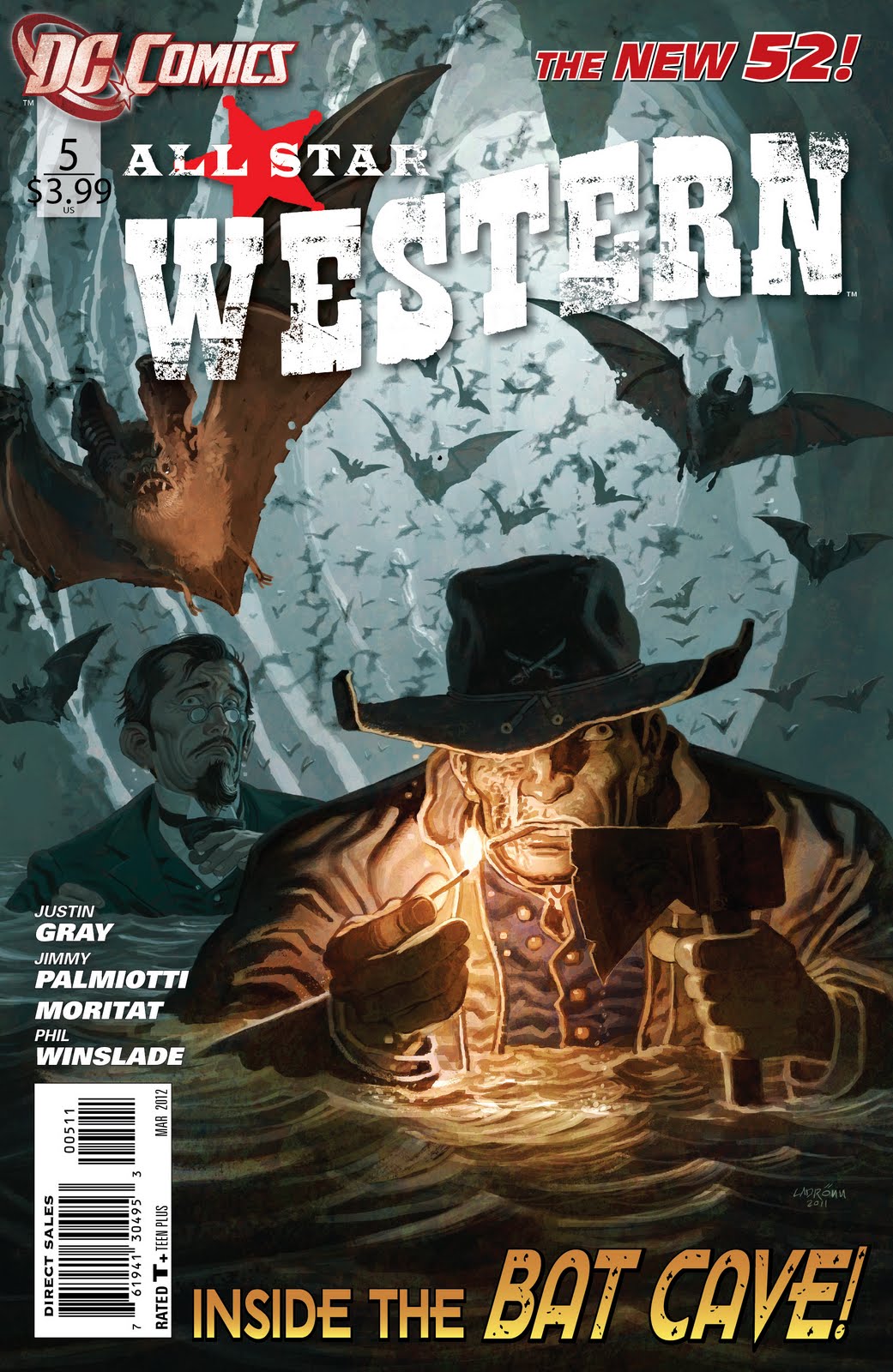
 ComicBookMovie.com reviews All-Star Western #5, and that assessment can be read here.
Monday, January 30, 2012

Sunday, January 29, 2012
Cape Town Community cites 'All-Star Western' #5 as "Book of the Week"
 All-Star Western scores another bullseye as Cape Town Community names it "book of the week." This review is also notable for shining a portion of its quite favorable spotlight on the backup feature, The Barbary Ghost, written by Justin Gray and Jimmy Palmiotti, and gorgeously illustrated by Phil (Wonder Woman: Amazonia) Winslade.
 The Barbary Ghost, as brought to evocative visual life by Phil Winslade.
(A word to the wise from the Buncheman: If you're the type who usually skips backup features, in the case of The Barbary Ghost, you'll be missing a brutal western tale of revenge told from the Chinese immigrant point of view. Trust me, it's a damned good read, and believe me when I state that I'm a total bitch when it comes to my appraisals of the comics I read.)
Cape Town Community's review can be read here.
'All-Star Western" #5 recieves the "buy" recommendation from ScienceFiction.com
 There is perhaps no more simple and eloquent form of critical appraisal that that of "buy," and that is exactly what ScienceFiction.com recommends you do in regard to All-Star Western #5, which they also declare a "sleeper hit." The review in question is found here.
Thursday, January 26, 2012
A look back: Gray and Palmiotti's 'Daughters of the Dragon'
 (art by Khari Evans)
So, having already scored a hit (of sorts) by mining the "blaxploitation" genre to come up with street-level super-brutha Luke Cage (aka Power-Man), Marvel wasted little time in cribbing its own chopsocky thrills into the ever-burgeoning ongoing tapestry that is the Marvel Universe, first with the blatantly Bruce Lee-modeled Shang-Chi, Master of Kung Fu, who was soon joined by the likes of Iron Fist (a character whose abilities were shamelessly "influenced" by Five Fingers of Death)and the Sons of the Tiger. Fun and ground-breaking though that stuff was, Marvel had pretty much glossed over one of the most important elements of the martial arts genre, and that missing aspect was that of the female badass, a storytelling trope that goes back for centuries in Asian legends, literature, and (more recently, obviously) film. That oversight was remedied with the introduction of Colleen Wing and Misty Knight, known in tandem as the Daughters of the Dragon.
As previously stated, Marvel paid careful scrutiny to what was going on in pop culture, so it could not have escaped their notice that the blaxploitation genre — still going strong at the time of the chopsocky boom's emergence — began to gene-splice martial arts into its funkified goings-on, so the Daughters of the Dragon took a modernized version of the female samurai slayer archetype, Colleen Wing, and paired her with a tough-as-nails, sassy, big-assed-gun-wielding black chick with a planet-sized Afro who was unmistakably modeled upon the indelible Pam Grier (a figure as synonymous with blaxploitation as Bruce Lee is with the kung fu genre), one Misty Knight by name. Moreso than any of Marvel's other attempts to nail the exact flavor of what they were trying to ape (with the notable exception Shang-Chi: Master of Kung Fu, when it was firing on all cylinders in its Moech-Gulacy years), the Daughters of the Dragon, most frequently seen as regular characters in Iron Fist's monthly book (and in the subsequent Power Man and Iron Fist series), absolutely got it right and proved to be a real crowd-pleaser of a pairing. Unfortunately, the solo stories featuring the characters were often wildly-varying in effect and were often a sad waste of great potential. Case in point: the sole "classic-era" D.O.D. story that everyone remembers and points to was the highly memorable Chris Claremont-Marshall Rogers black-and-white two-parter that ran in the Deadly Hands of Kung-Fu magazine in 1977. After that story, a work of more than enough kickass content to warrant the green-lighting of an ongoing series, little of note was done with the badassed babes for the better part of the next three decades.
Anyway, all of the aforementioned was an admittedly long-winded way of giving you some background before bringing things up to a more contemporary period and focusing on the efforts of Paperfilms' own Justin Gray and Jimmy Palmiotti in the handling of the Daughters of the Dragon.

Aided and abetted by the dynamic artwork of Khari Evans, the six-issue Daughters of the Dragon mini-series, collected under the title Samurai Bullets, is packed to the rafters with non-stop action and characterization, liberally seasoned with the kind of humor once common in fused genre of chopsocky and blaxploitation. If you groove on old school badassery with that distinctly East-meets-West wakka-jawaka flavor, this series is for you (and it can be had via Amazon). But why take just my word for it? There's a very good review of the series over at Comic Book Resources, so click here for a well-informed second opinion.
A very special review of 'All Star Western' #5 at Mulitiversity Comics
 Every now and the a review comes along that looks at a particular subject of appraisal and goes above and beyond the call of criticism to provide the reader with all they will ever need to know about exactly what makes said series worthy of their attention, time and money. Such a review is found here, over at Multiversity Comics. Seriously, they tackle not only the merits of the latest issue of All Star Western, they also address the whole appeal of Jonah Hex as one of the last holdouts in what used to be a popular media landscape replete with westerns. A more heartfelt review has seldom been seen in the annals of Internet comics geekery, and such an effort is to be both heartily recommended and commended.
Justin & Jimmy discuss their take on 'Unknown Soldier' at The Source
 The Source, DC Comics' own blog, is currently featuring what Unknown Soldier scripters Justin Gray and Jimmy Palmiotti have to say on their revamp of the character for the upcoming G.I. Combat anthology, and you can read those insights when you follow this link.
And speaking of 'G.I. Combat'...
 Crave Online is currently running a preview of the upcoming G.I. Combat's Gray & Palmiotti-scripted Unknown Soldier that shows off artist Dan Panosion's efforts with some impressively large scans, so head here to get a serious eyeful!
Subscribe to:
Posts (Atom)